
Conversion Table Cooking
Recipes from different countries measure in different ways: cups and ounces in the US, grams and millilitres almost everywhere else, gas marks in older British cookbooks. This page converts all of them — volume, weight, oven temperature — and turns cups into grams for common ingredients, because a cup of flour weighs about half as much as a cup of sugar. Print the charts for the fridge door.
- Free to use
- No sign-up
- Runs in your browser
Kitchen conversion calculator
Oven temperature
Kitchen Conversion Charts
Printable kitchen conversion chart, cups-to-grams baking chart, oven temperature card and a recipe scaling worksheet.
- Conversion chart (PDF/XLSX)
- Cups to grams (PDF/XLSX)
- Oven card (PDF)
- Scaling worksheet (XLSX)
Formats: PDF, XLSX. Instant download after payment (link valid 72 hours, up to 5 downloads). AI-assisted: the templates were drafted with AI help and reviewed and laid out before publishing.
$5.00 USD, one-time 4 files · about $1.25 each
- Instant download
- 7-day refund
- Secure checkout by Stripe
7-day money-back guarantee. Full refund within 7 days of purchase, even after you download.
Free sample: Kitchen Conversion Chart (PDF, 106 KB)
Full refund within 7 days — see the refund policy and license.
Free printables
Single sheets you can print right now, no sign-up. The full pack adds every sheet in one download plus the editable files.
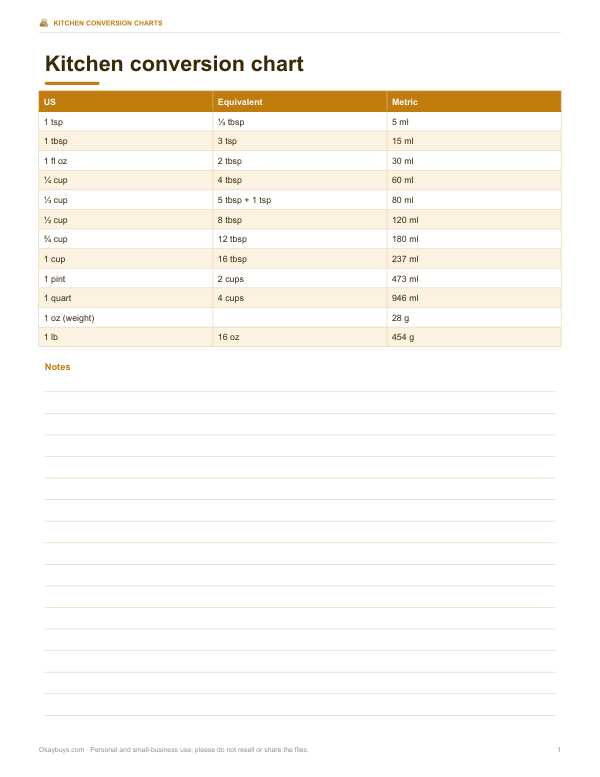 Printable Kitchen Conversion Chart
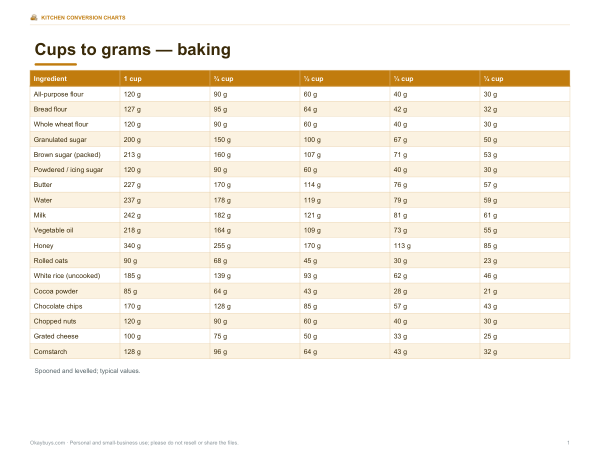 Printable Cups to Grams Chart
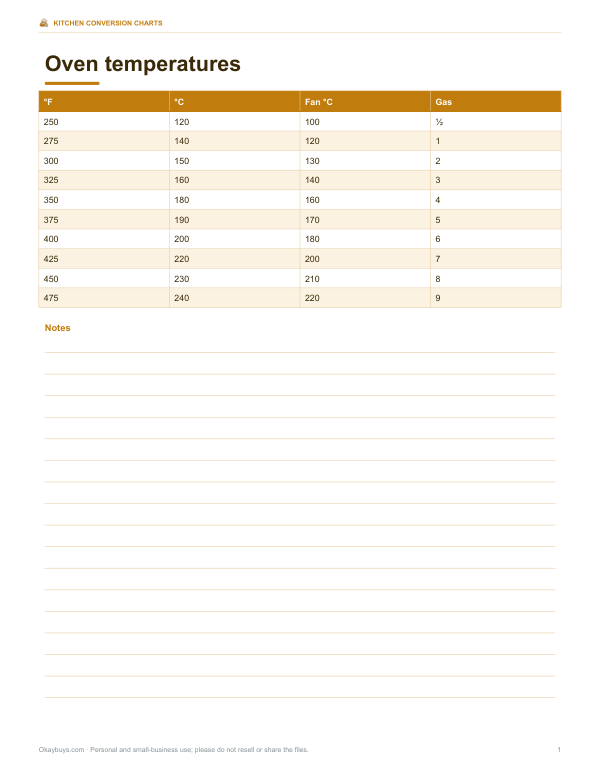 Printable Oven Temperature Chart
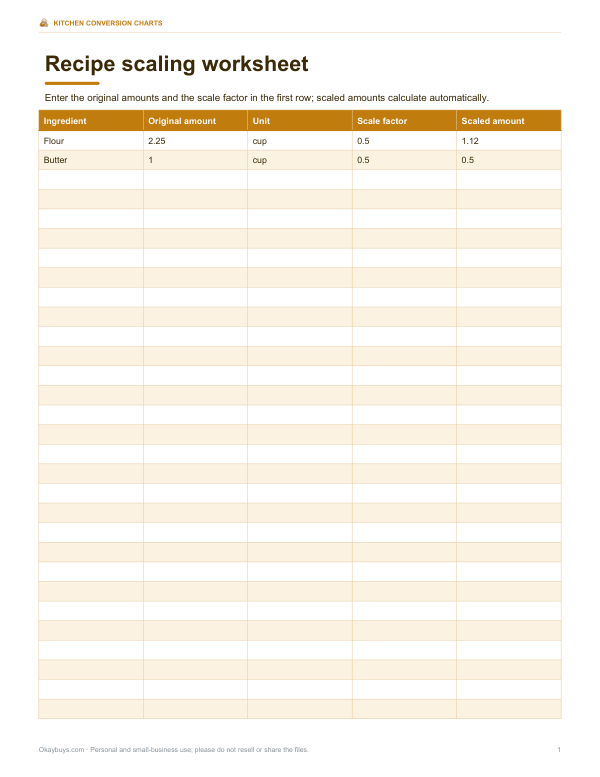 Printable Recipe Scaling Worksheet
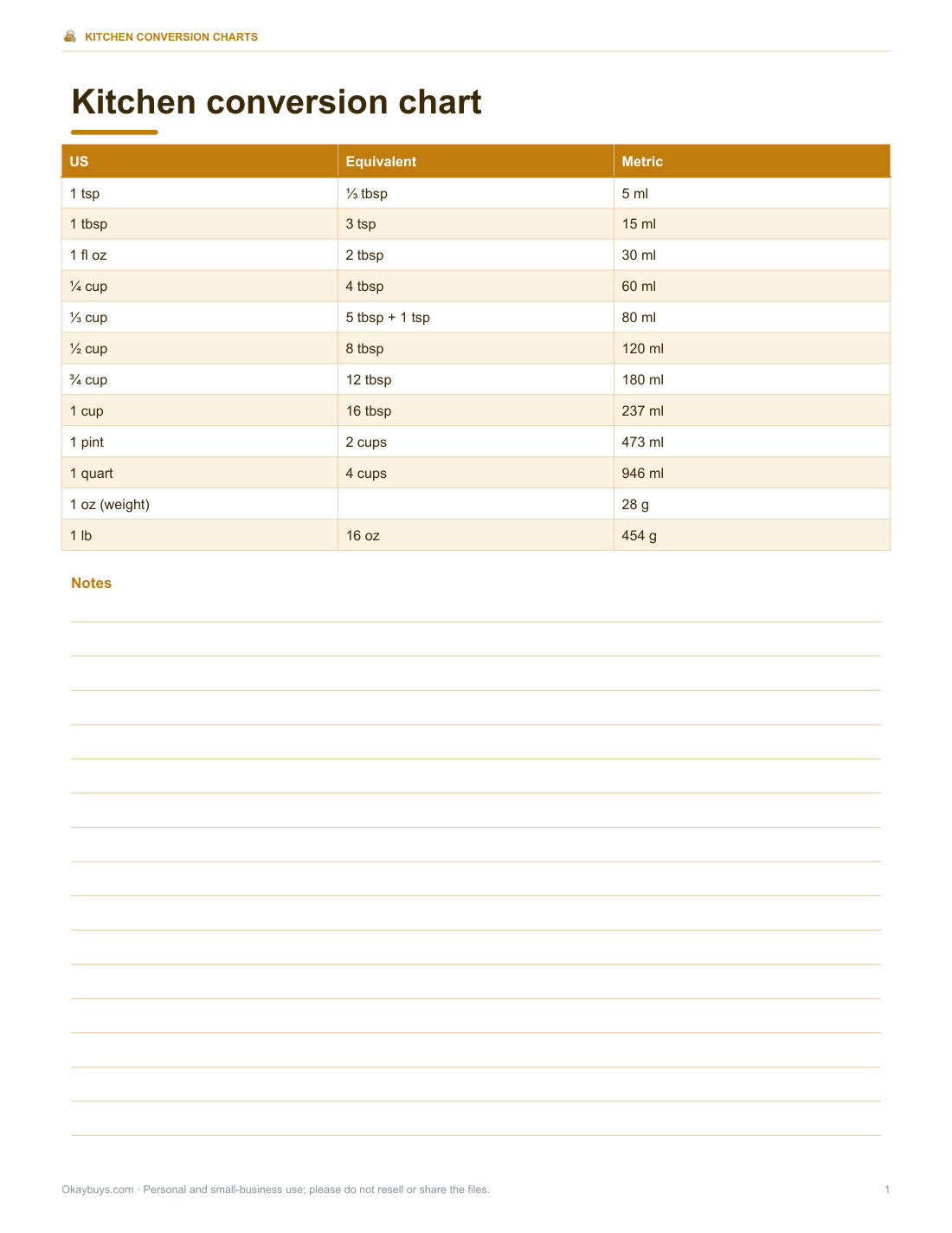
Volume conversions
| US measure | Equivalent | Metric (approx.) |
|---|---|---|
| 1 teaspoon | ⅓ tablespoon | 5 ml |
| 1 tablespoon | 3 teaspoons | 15 ml |
| 1 fluid ounce | 2 tablespoons | 30 ml |
| ¼ cup | 4 tablespoons | 60 ml |
| ⅓ cup | 5 tbsp + 1 tsp | 80 ml |
| ½ cup | 8 tablespoons | 120 ml |
| 1 cup | 16 tablespoons / 8 fl oz | 237 ml |
| 1 pint | 2 cups | 473 ml |
| 1 quart | 4 cups | 946 ml |
| 1 gallon | 4 quarts | 3.8 litres |
A metric cup (used in Australia, New Zealand and Canada in many recipes) is 250 ml, slightly larger than the US cup. An Australian tablespoon is 20 ml rather than 15 ml, so check where a recipe comes from.
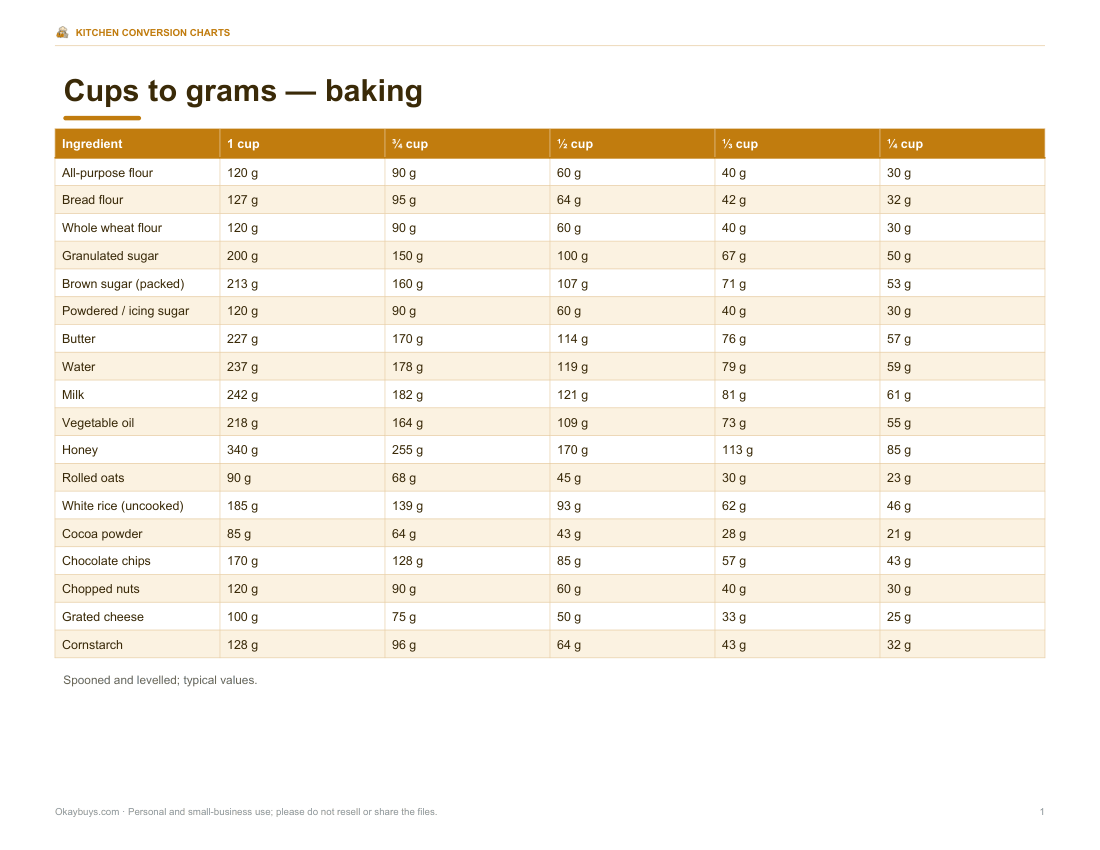
Cups to grams for common ingredients
| Ingredient | 1 cup | ½ cup | 1 tablespoon |
|---|---|---|---|
| All-purpose flour | 120 g | 60 g | 7.5 g |
| Bread flour | 127 g | 64 g | 7.9 g |
| Whole wheat flour | 120 g | 60 g | 7.5 g |
| Granulated sugar | 200 g | 100 g | 13 g |
| Brown sugar (packed) | 213 g | 107 g | 13 g |
| Powdered / icing sugar | 120 g | 60 g | 7.5 g |
| Butter | 227 g | 114 g | 14 g |
| Water | 237 g | 119 g | 15 g |
| Milk | 242 g | 121 g | 15 g |
| Vegetable oil | 218 g | 109 g | 14 g |
| Honey | 340 g | 170 g | 21 g |
| Rolled oats | 90 g | 45 g | 5.6 g |
| White rice (uncooked) | 185 g | 93 g | 12 g |
| Cocoa powder | 85 g | 43 g | 5.3 g |
| Chocolate chips | 170 g | 85 g | 11 g |
| Chopped nuts | 120 g | 60 g | 7.5 g |
| Grated cheese | 100 g | 50 g | 6.3 g |
| Cornstarch | 128 g | 64 g | 8.0 g |
These are typical values for ingredients spooned into the cup and levelled. Scooping flour straight from the bag packs it down and can add 20% or more, which is why bakers prefer scales.
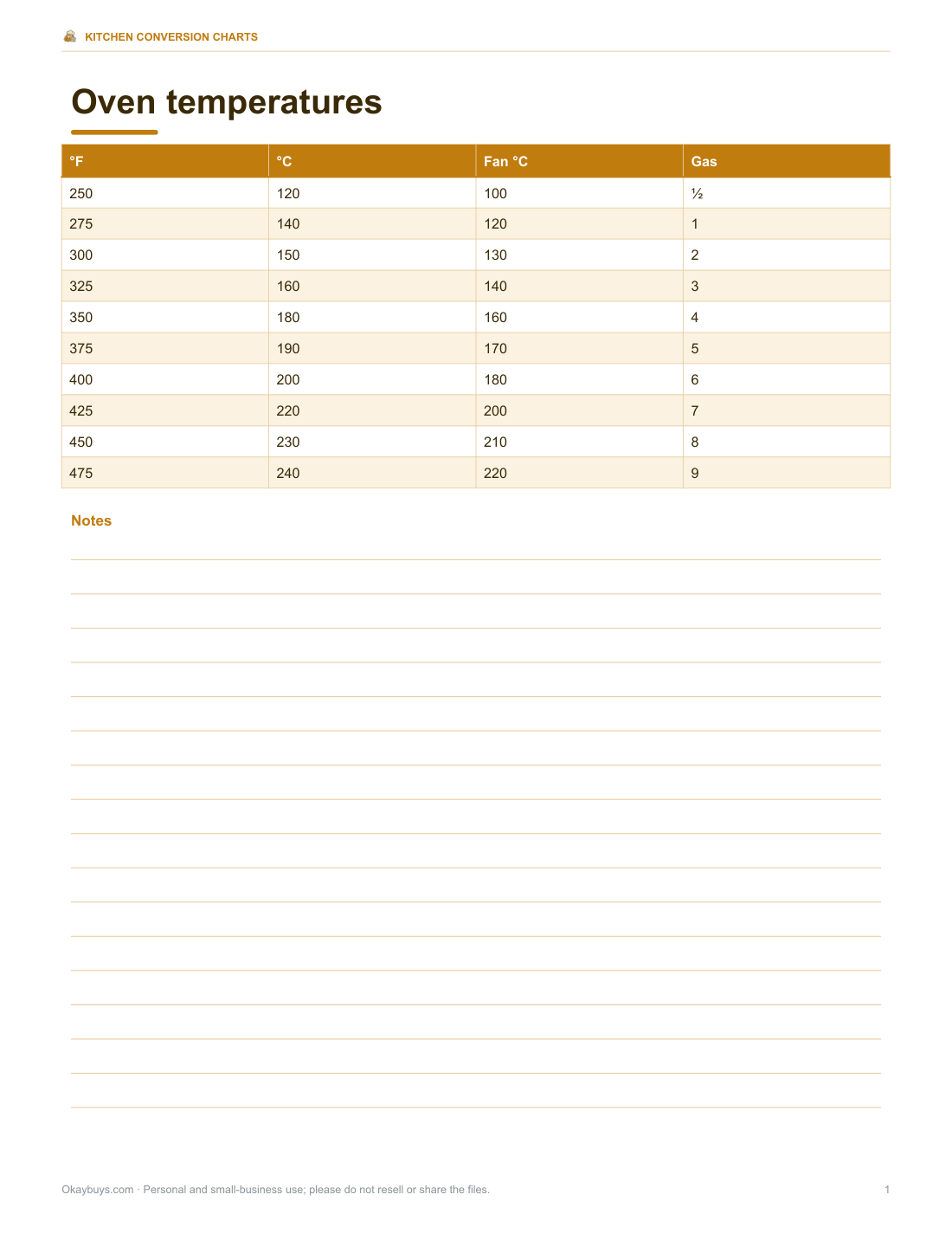
Oven temperatures
| °F | °C | Gas mark | Description |
|---|---|---|---|
| 250 | 120 | ½ | Very low |
| 275 | 140 | 1 | Very low |
| 300 | 150 | 2 | Low |
| 325 | 160 | 3 | Moderately low |
| 350 | 180 | 4 | Moderate |
| 375 | 190 | 5 | Moderately hot |
| 400 | 200 | 6 | Hot |
| 425 | 220 | 7 | Hot |
| 450 | 230 | 8 | Very hot |
| 475 | 240 | 9 | Very hot |
Fan (convection) ovens cook faster; a common adjustment is to reduce the temperature by about 20 °C (25 °F) or shorten the time. Always check the recipe — many modern recipes state both settings.
Weight conversions
| Imperial | Metric |
|---|---|
| 1 oz | 28 g |
| 4 oz (¼ lb) | 113 g |
| 8 oz (½ lb) | 227 g |
| 12 oz | 340 g |
| 1 lb (16 oz) | 454 g |
| 2.2 lb | 1 kg |
Worked example: converting a US cookie recipe
A recipe calls for 2¼ cups of flour, 1 cup of butter and ¾ cup of packed brown sugar. Using the table, that is about 270 g flour (2.25 × 120), 227 g butter (two US sticks) and 160 g brown sugar (0.75 × 213). If you want to make half the batch, set the scale to 0.5 in the calculator and every quantity halves. For a 350 °F oven, use 180 °C, or about 160 °C in a fan oven.
Measuring tips
- Spoon flour into the cup and level it with a knife — don’t scoop.
- Pack brown sugar firmly unless the recipe says otherwise.
- Measure liquids at eye level in a clear jug.
- For sticky ingredients like honey, lightly oil the spoon first.
- Use a digital scale for baking — it is faster and more accurate.
- Butter wrappers in the US show tablespoon markings; 1 stick = 8 tbsp = ½ cup = 113 g.
Butter, eggs and other tricky conversions
| Ingredient | Conversion |
|---|---|
| Butter | 1 US stick = ½ cup = 8 tbsp = 113 g; a UK/EU block is usually 250 g |
| Eggs | A large egg is about 50 g without the shell (about 3 tbsp) |
| Yeast | 1 packet of dried yeast is about 7 g (2¼ tsp) |
| Gelatine | 1 packet (US) is about 7 g |
| Baking powder | 1 tsp is about 4 g |
| Salt | 1 tsp of table salt is about 6 g; flaky or kosher salt is lighter |
Scaling recipes
Multiplying every ingredient works well for most savoury dishes and many bakes, but be careful with very large changes. Pan size changes the depth and baking time; leavening (baking powder, yeast) and salt sometimes need less than a straight multiplication in big batches; and spices can be adjusted to taste. When halving recipes that use one egg, beat the egg and use half by weight (about 25 g).
Printable charts
The optional pack includes a printable kitchen conversion chart for the fridge, a cups-to-grams baking chart, an oven temperature card and a recipe scaling worksheet. The converter above is free.
AI-assisted content
This page was drafted with AI assistance and reviewed before publishing. Ingredient weights are typical values; check your recipe’s own guidance.
Frequently asked questions
How many grams is 1 cup of flour?
About 120–125 g when spooned and levelled.
How many tablespoons are in a cup?
16 US tablespoons.
What is 350 °F in Celsius?
About 180 °C (gas mark 4).
How many ml is a cup?
A US cup is about 237 ml; a metric cup is 250 ml.
How many grams is a stick of butter?
About 113 g (½ cup).
Should I reduce the temperature for a fan oven?
Usually by about 20 °C (25 °F), unless the recipe says otherwise.
How many teaspoons are in a tablespoon?
Three in the US and UK; four in Australia, where a tablespoon is 20 ml.